Loosen · for tight movers
Teach your muscles to go from screaming to a whisper
Bring a stretch from 6–7 out of 10 down to 2–3, without going deeper.
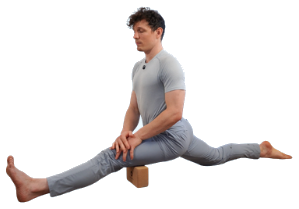
AWhy it works
Most of the range you gain in the first weeks isn't longer muscle. It's your nervous system accepting more stretch.1,2 That's a skill, and it grows when you're:
- SafeFully supported, nothing to balance. A body that feels unstable keeps guarding.
- CalmLong, slow exhales shift you toward rest and recovery.3 A calmer system lets go more easily.
BDose and tracking
Progress: fewer exhales to reach 2–3, then less support. Never sore the next day. Log both numbers.
CThe steps
Setup: anything you can rest your full weight on. A wall, a heavy table, thick blocks, cushions, sandbags.
- 1
Lift in and out
3–5 slow lifts in and out of your end position. Your body learns it can get out.
- 2
Find a 6–7
Settle where the stretch feels 6–7 out of 10. In the muscle, never the joint.
- 3
Prop yourself up
Same depth, more support, until you can rest your full weight.
- 4
Exhale to turn it down
Long, slow exhales through pursed lips. Sink into the props on each one. Count until you reach 2–3.
- 5
Look for room, don't push
Still at 6–7 after 5 exhales? Add support or change the angle, not the depth.
- 6
Contract to soften
Tense the stretched muscle at half effort for 2–3 seconds, then let go on an exhale.4
- 7
Leave slowly
Come out with control. Note support used and exhales.
DWhen it gets stuck
| Muscles grip harder the deeper you go | Add support, then exhale. |
| Stuck at 6–7 after 5 exhales | Step 5: look for room. |
| Sore the next day | More support, 1 set per side. |
| Joint pain, tingling or numbness | Come out and change position. If it keeps coming back, get it checked. |
Research
- Weppler & Magnusson (2010). Increasing muscle extensibility: a matter of increasing length or modifying sensation? Physical Therapy, 90(3), 438–449. doi
- Freitas et al. (2018). Can chronic stretching change the muscle-tendon mechanical properties? A review. Scandinavian Journal of Medicine & Science in Sports, 28(3), 794–806. doi
- Zaccaro et al. (2018). How breath-control can change your life: a systematic review on psycho-physiological correlates of slow breathing. Frontiers in Human Neuroscience, 12, 353. doi
- Hindle et al. (2012). Proprioceptive neuromuscular facilitation (PNF): its mechanisms and effects on range of motion and muscular function. Journal of Human Kinetics, 31, 105–113. doi