Build · for limber movers
Target, dip, relax
Grow strength and relaxation in the same set.
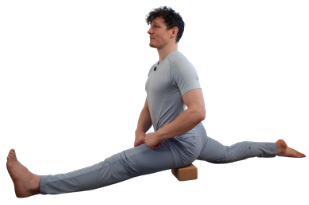
AWhy it works
Limber means 2 skills: strength where you're long, and letting go there. Strength work through full range builds range about as well as stretching,1 and most early gains come from accepting more stretch.2 TDR trains both:
- Target and dipYou move in and out under your own control.
- RelaxSupported and calm, you sink further.
BDose and tracking
Progress: the target moves further at the same comfort, you end deeper, and it shows in your skills. Log one number per set.
CThe steps
Setup: warm up, then a target you can nudge (like a block on a slider) and something sturdy for your hands.
- 1
Target
Move in and out, nudging the target a little further each rep. Stop at a comfortable max.
- 2
Dip
When the target stops, change the angle: fold or lean in. Range often frees up.
- 3
Relax
Let the props take your weight. Exhale long and sink.
- 4
Contract to soften
Optional: tense for 3–5 seconds, let go on an exhale, settle deeper.3
- 5
Measure and leave
Note where you ended. Come out with control.
DWhen it gets stuck
| Relax doesn't take you deeper | More support. Still stuck? A week of Loosen. |
| Deep when relaxed, but you can't lift out | A few weeks of Strengthen. |
| Good range, but not in your skills | Add dynamic kicks into a target. |
| Joint pain, tingling or numbness | Stop and change position. If it keeps coming back, get it checked. |
Research
- Afonso et al. (2021). Strength training versus stretching for improving range of motion: a systematic review and meta-analysis. Healthcare, 9(4), 427. doi
- Weppler & Magnusson (2010). Increasing muscle extensibility: a matter of increasing length or modifying sensation? Physical Therapy, 90(3), 438–449. doi
- Hindle et al. (2012). Proprioceptive neuromuscular facilitation (PNF): its mechanisms and effects on range of motion and muscular function. Journal of Human Kinetics, 31, 105–113. doi